
Build your first chatbot
A chatbot holds a whole conversation for you. It sends a menu, asks a question, remembers the answer, asks the next one, and hands the customer to your team or your AI assistant when it should. You draw it as boxes and lines on a canvas; your customer just sees an ordinary WhatsApp chat.
It sits between the two other ways Wap2b answers on its own:
- Instant Replies answer one question with one reply. No memory — every message is checked fresh.
- A chatbot remembers where each customer is. "Book a visit" → "What's your name?" → "Which branch?" is one chatbot.
- Your AI assistant answers anything you haven't scripted. A chatbot can hand over to it at any point.
One charge per run
A chatbot is charged once per run — each time it starts with a customer — however many messages it sends in that run. See Pricing. Its messages count toward your number's free service messages for the month, like every reply; past them, each one is charged. The label at the top of the canvas shows what one run costs — click it for the breakdown.
Open Chatbots
In the sidebar, under Automation, between Instant Replies and AI Assistants. Chatbots belong to one WhatsApp number; if you have more than one, pick the number at the top right.
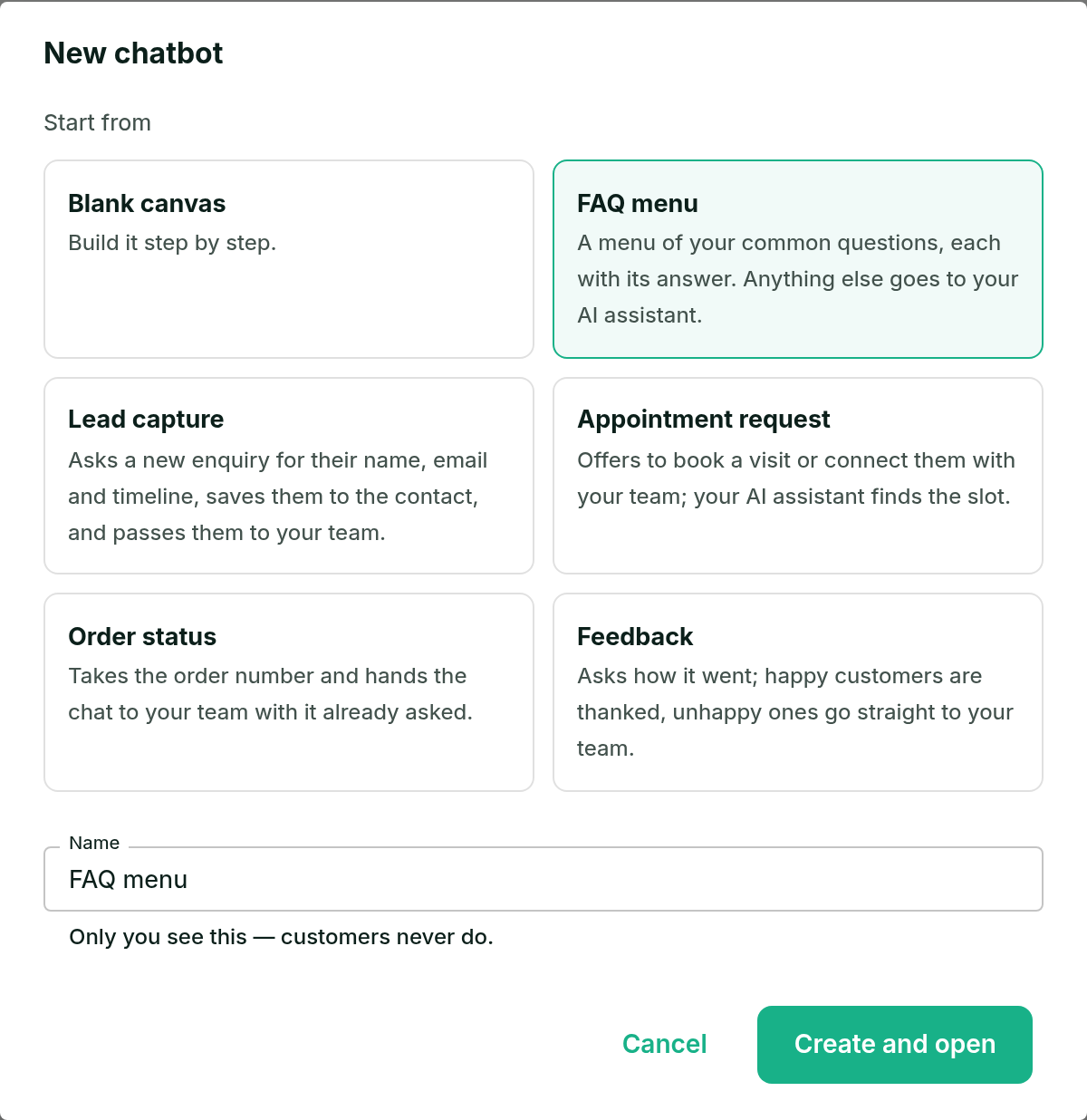
Start from a ready-made chatbot
Click + New chatbot. You can start from a blank canvas, but it's quicker to start from one of the ready-made ones and change the words — each one is complete and can be published the moment it opens.
The canvas
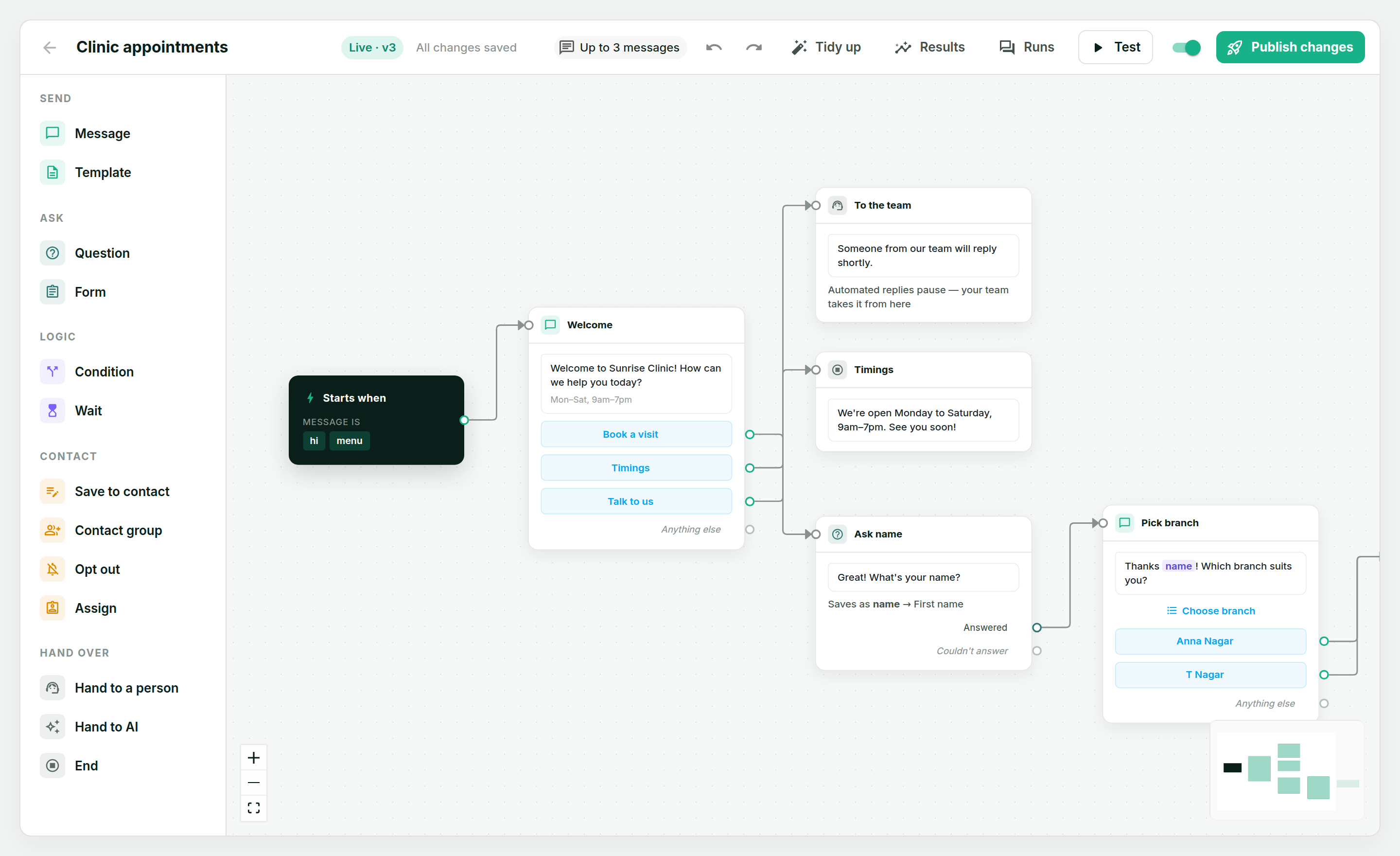
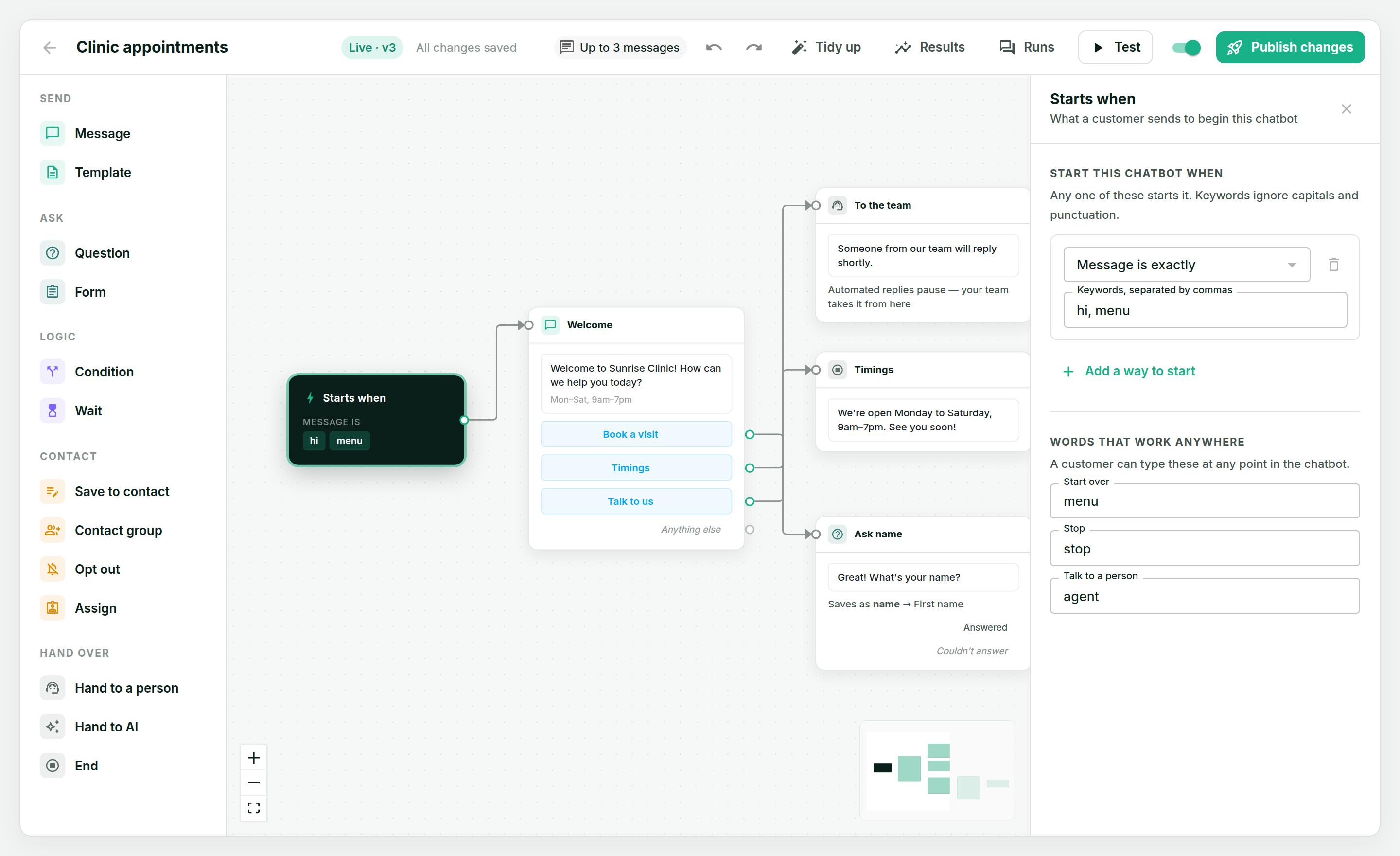
- The dark box, "Starts when", is what starts the chatbot — words a customer sends, the very first message they send you, any message at all, or a click on one of your ads. Click it to change them.
- Every other box is a step. A message box shows the message as a WhatsApp bubble, with its buttons underneath. Words in purple, like name, are filled in from an earlier answer.
- Lines go from the small circle on the right of a box to the next step. Drag from a circle to a box to draw one; click a line and press Delete to remove it.
Everything saves by itself as you work. Nothing reaches a customer until you press Publish.
Add steps
Drag a step from the palette on the left onto the canvas, or click it to drop it in the middle. One chatbot holds up to 50 steps. If a conversation needs more branches than that, it has stopped being a script — hand the open-ended part to an AI assistant instead. The steps you can use:
| Step | What it does |
|---|---|
| Message | Text, a picture, video or document, and optionally up to 3 buttons or a list of up to 10 options |
| Template | An approved template — the only thing WhatsApp lets you send after 24 hours of silence |
| Question | Asks something and waits for a typed answer — any text, a number, an email or a phone number |
| Form | Sends one of your published WhatsApp Flows and waits for it to be submitted |
| Condition | Goes one way or another: by an answer, a contact field, a group, or whether you're open |
| Wait | Pauses before the next step — see Waits and follow-ups |
| Save to contact | Writes a value onto the contact |
| Contact group | Adds the contact to a group, or takes them out — handy for a broadcast later |
| Opt out | Stops marketing messages to this contact |
| Assign | Gives the chat to someone on your team, and carries on |
| Hand to a person | Ends the chatbot; automated replies pause so your team can take over |
| Hand to AI | Ends the chatbot; your AI assistant answers from here |
| End | Ends the chatbot, with an optional last message |
Edit a step
Click any box to open its settings on the right.
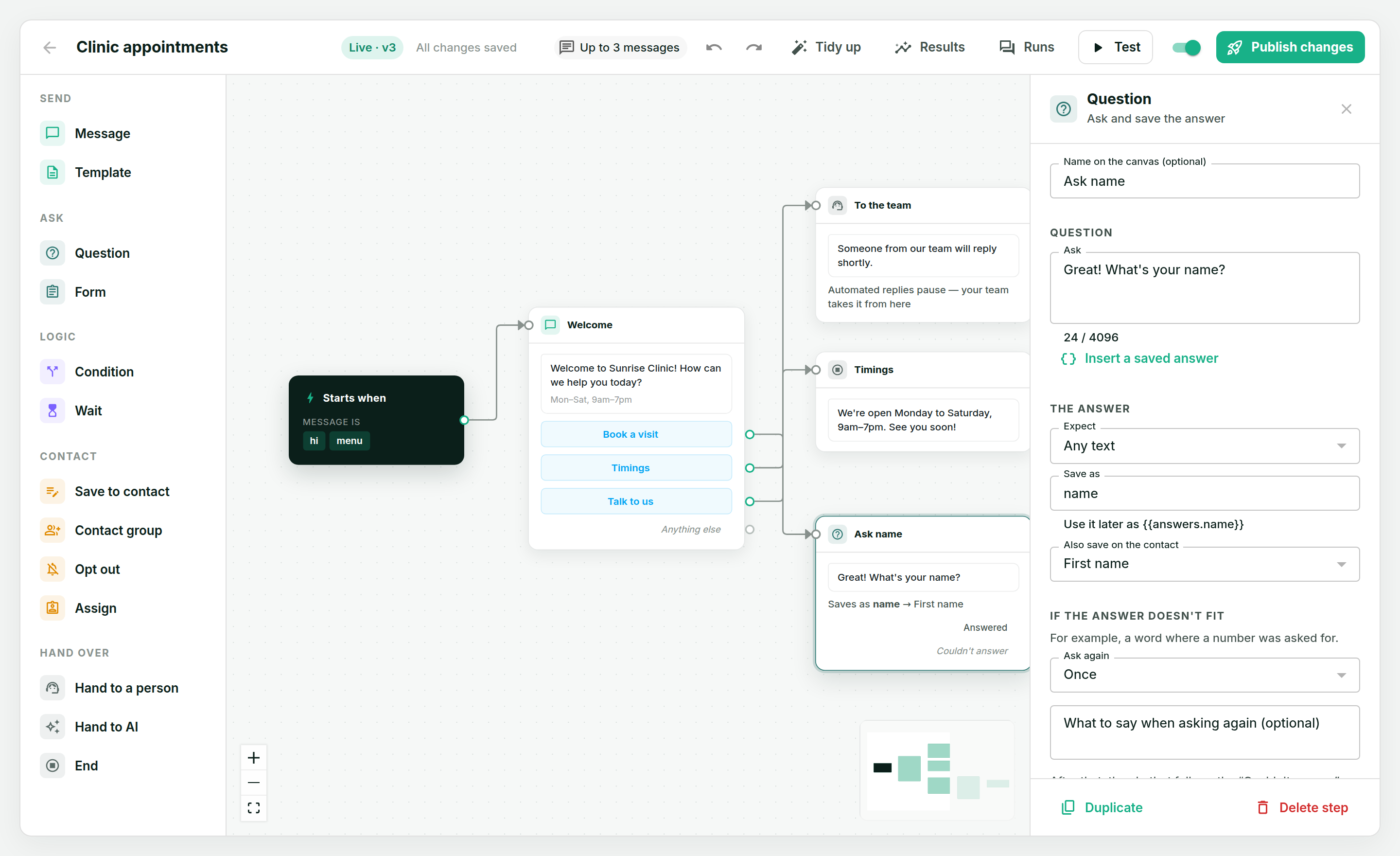
To use an earlier answer in a message, click Insert a saved answer under the text. If the
customer's first name is saved, Thanks {{answers.name}}! arrives as "Thanks Priya!".
A line to nowhere is fine
You don't have to connect everything. A button with no line leading from it simply ends the chatbot, and the customer's tap goes wherever it would have gone without one — your Instant Replies, then your AI assistant. A half-built branch never leaves a customer talking to silence.
The End step is different: it's you deciding the conversation is over, so nothing else answers that message.
Words that work anywhere
Click "Starts when" to see them. A customer who types menu starts again, stop ends the chatbot, and agent hands them to your team — from any step. You can change the words.
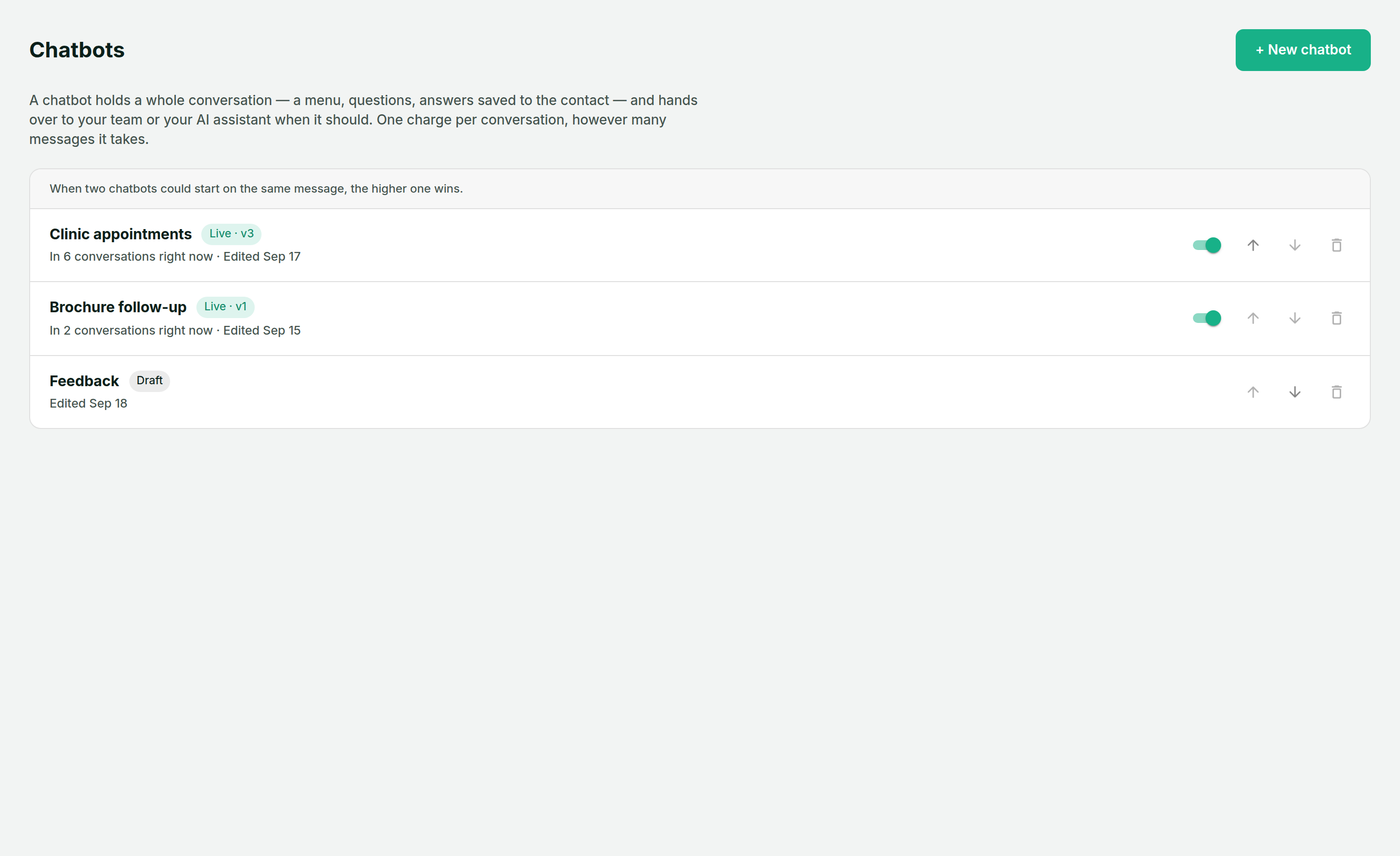
When two chatbots could start
On the Chatbots page, the list is also the order. If a customer's message could start two of your chatbots, the one higher in the list wins. Use the arrows to move them. A chatbot also always goes before your Instant Replies, and both go before your AI assistant.
Next: Test and publish a chatbot.